
Few growers do not know that, with the exception of autoflowering varieties, cannabis flowering depends on photoperiod, that is, the length of day and night. A less well-known fact is that behind plant photoperiodism lies a sophisticated system that can be as precise as clockwork. How do plants know whether it is day or night outside, and according to what do they regulate flowering?
Unlike us humans, who only need to look at the sky, plants regulate their internal clocks according to receptors in the leaves called phytochromes. Depending on whether, and what kind of, light shines on them, phytochromes can “switch” into two different forms designated Pr and Pfr.
In the morning after a dark night, most phytochromes in the plant are in the inactive Pr form. However, as soon as light begins to shine on the photoreceptors, they start changing from the Pr type back to Pfr. During the day, the amount of Pfr phytochromes in the plant increases, while the speed and amount of converted photoreceptors depend on the spectrum, shading and temperature. At evening dusk and during the night, the Pfr phytochromes begin to convert back to Pr again.
This balanced system allows plants to recognise not only whether the sun is currently shining on them, but above all to measure the length of day and night precisely and time flowering. Depending on how the ratio of Pr to Pfr changes during the night, they can tell how long the night lasted and whether they should move from vegetative growth to flowering.
You may be interested in: What substances cannabis contains
How many hours of darkness do cannabis plants need to flower?
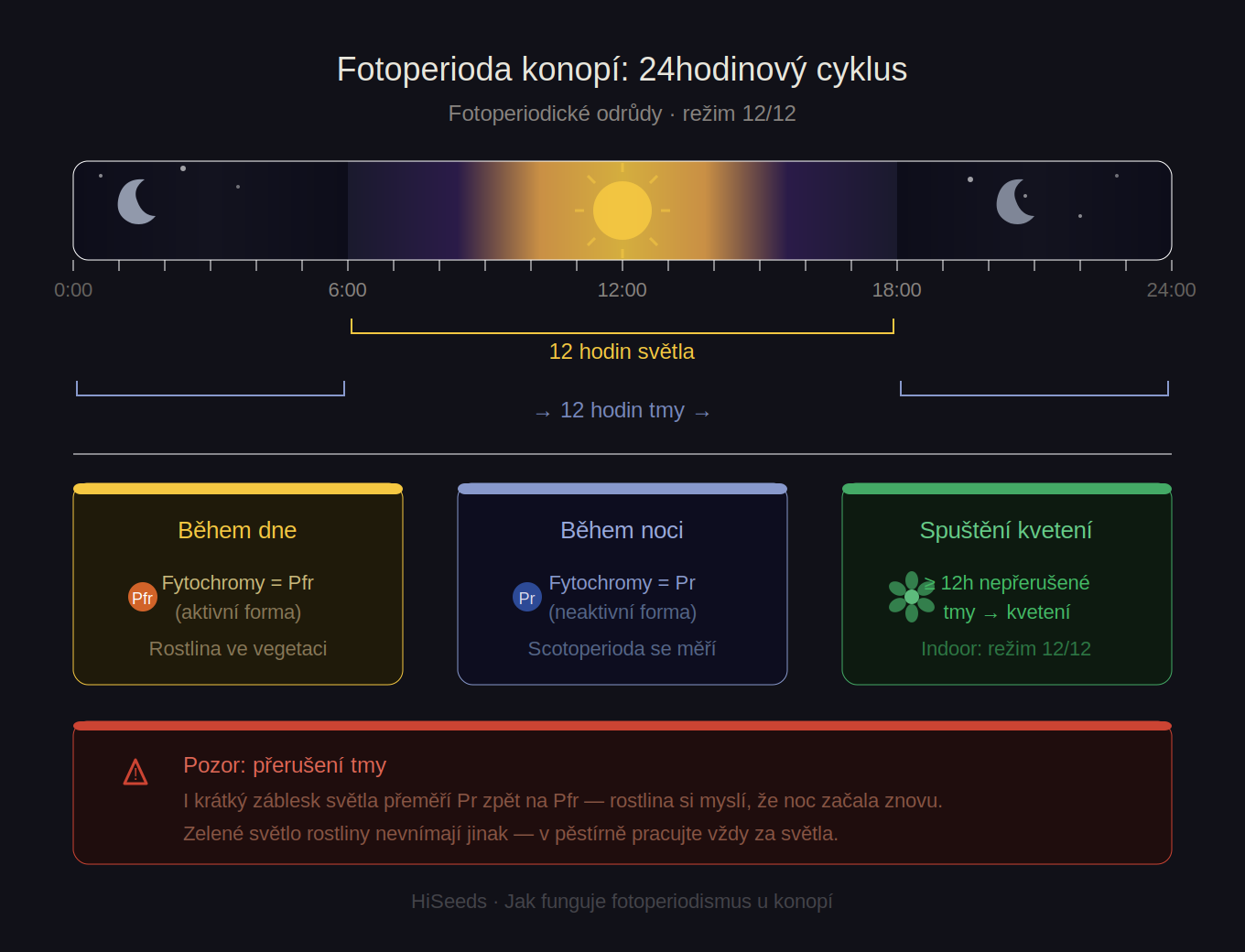 Most growing guides state that cannabis plants need 12 hours of darkness to trigger flowering. In reality, the required night length is slightly shorter and also depends on the variety. Many photoperiod varieties begin to flower with 10 or more hours of darkness (1). This applies above all to those originating from northern regions, where days shorten more slowly in summer.
By contrast, varieties from equatorial regions (“sativas”), where the length of day and night does not change much, need slightly longer darkness approaching 12 hours to begin flowering. That is why they are not very suitable for outdoor growing here. Not only do they have a long flowering time, but they also start flowering only late in summer, often not until the second half of August, and do not have time to ripen before autumn. For the sake of completeness, we should add that when growing indoors, you should keep to the usual 12/12 regime during flowering, which works for all photoperiod cannabis varieties.
You may be interested in: How to choose cannabis seeds for indoor and outdoor growing
It is important that no light disturbs the plants during the night, ideally not even for a moment. This is because plants do not actually measure the length of the day, but the length of continuous darkness, the so-called scotoperiod. If something lights up the leaves during the night, part of the phytochromes converts back to the active Pfr form and the plant thinks that night has started again. It has been shown that even weak light, for example from a street lamp or an indicator light, is enough to significantly slow down or completely stop flowering (2).
The practical conclusion is that if you grow outdoors and cannot guarantee enough darkness for the plants, it is better to grow from seeds of autoflowering varieties, which flower independently of the length of day and night. For indoor growers, it applies that the grow box or grow room must be completely dark. We would also like to dispel the myth of green light being “invisible” to plants. It is true that green light is not as effective in converting phytochrome, but plants certainly do respond to it. Always plan all work in the grow room for the time when the grow lights are on.
For more interesting facts and guides from the world of cannabis, follow the HiSeeds blog and our social media channels.