
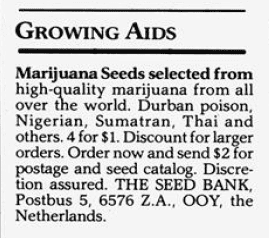
 “Marijuana seeds selected from first-class marijuana from around the world. Durban poison, Nigeria, Sumatra, Thailand and more. 4 for $1. Discounts on larger orders.” Order now and send $2 for postage and a seed catalogue. Discretion guaranteed.” These few lines published in July 1984 in High Times magazine changed the world of cannabis forever. Their author was Nevil Schoenmakers, a cannabis grower and breeder living in Holland, whom many consider the spiritual father of modern seed banks.
Holland in the 1980s was, thanks to its tolerant drug laws, a refuge for members of the underground from various parts of the world. One of them was Nevil Schoenmakers, an Australian with Dutch roots who arrived in Amsterdam at the end of the 1970s. Nevil fled his native Australia after getting into trouble with the law there over selling cannabis. In addition to the threat of punishment, Nevil was also suffering from heroin addiction at the time. Unfortunately, heroin was easily available in the Dutch capital, so his situation during the first few years in Holland did not look rosy at all. Nevertheless, after some time Nevil managed to stop using heroin, largely thanks to cannabis, as he himself admitted in one interview.
From junkie to grower
At the beginning of the 1980s, inspired by a book by the American authors Ed Rosenthal and Mel Frank describing indoor cannabis cultivation, Nevil bought the necessary equipment and converted the shed behind his house into a grow room. At first, he grew from seeds of landrace varieties from Nigeria, Colombia and Mexico, which he obtained from cannabis bought in Amsterdam coffeeshops. However, he did not meet with much success. Hash oil was popular on the black market, and there was no demand for his home-grown cannabis.
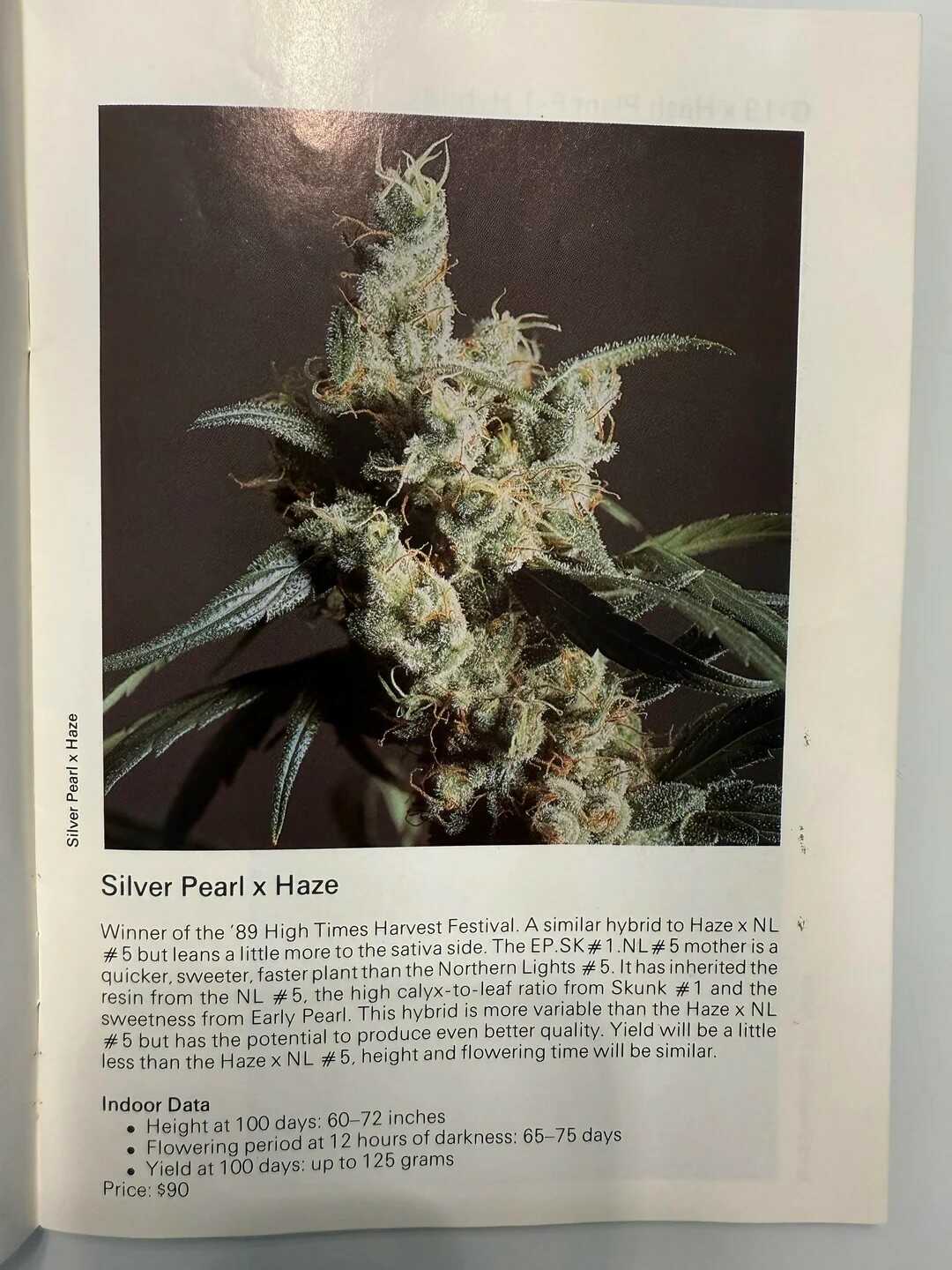 As a young man back in his Australian homeland, Nevil had been a passionate breeder of parrots, and therefore he was very familiar with the laws of genetics. He knew that if he could cross his sativa equatorial varieties with quality indicas, he could grow much better cannabis. The difficulty was that cannabis seeds with a high THC content were practically available in the 1980s only in three ways. Either you found them in bought imported cannabis, which was often grown outdoors and contained seeds. Alternatively, you travelled to the place of origin of the seeds, exotic and often hard-to-reach countries with traditional cannabis cultures. The last way to obtain first-class cannabis seed was from one of the underground growers in the United States, who had been breeding and tending their varieties at least since the end of the 1960s.
Faced with this problem, an idea begins to form in Nevil’s mind. After consulting a lawyer, he finds out that under Dutch law the sale of cannabis seeds is legal. He decides to become the first international cannabis seed trader and in 1984 founds The Seed Bank of Holland. In an effort to gain contacts overseas, he has an advert published in High Times magazine, but at first there are only a few interested parties. However, luck smiles on Nevil and, by coincidence, he meets the legendary cannabis breeder David Watson, better known as Sam Skunkman. In the mid-1980s, he fled the American authorities to Holland, taking with him about 250,000 seeds of the best varieties.
Castle of the King of Cannabis
Nevil obtains his best varieties from Sam Skunkman, among them Skunk # 1 and Haze, which are among the most famous in cannabis history. In the following years, they become the basis of his breeding work. Nevil discovers that by selling seeds of his newly bred varieties overseas he can make considerably more money than he ever could by growing and selling cannabis, moreover without the risk of prosecution.
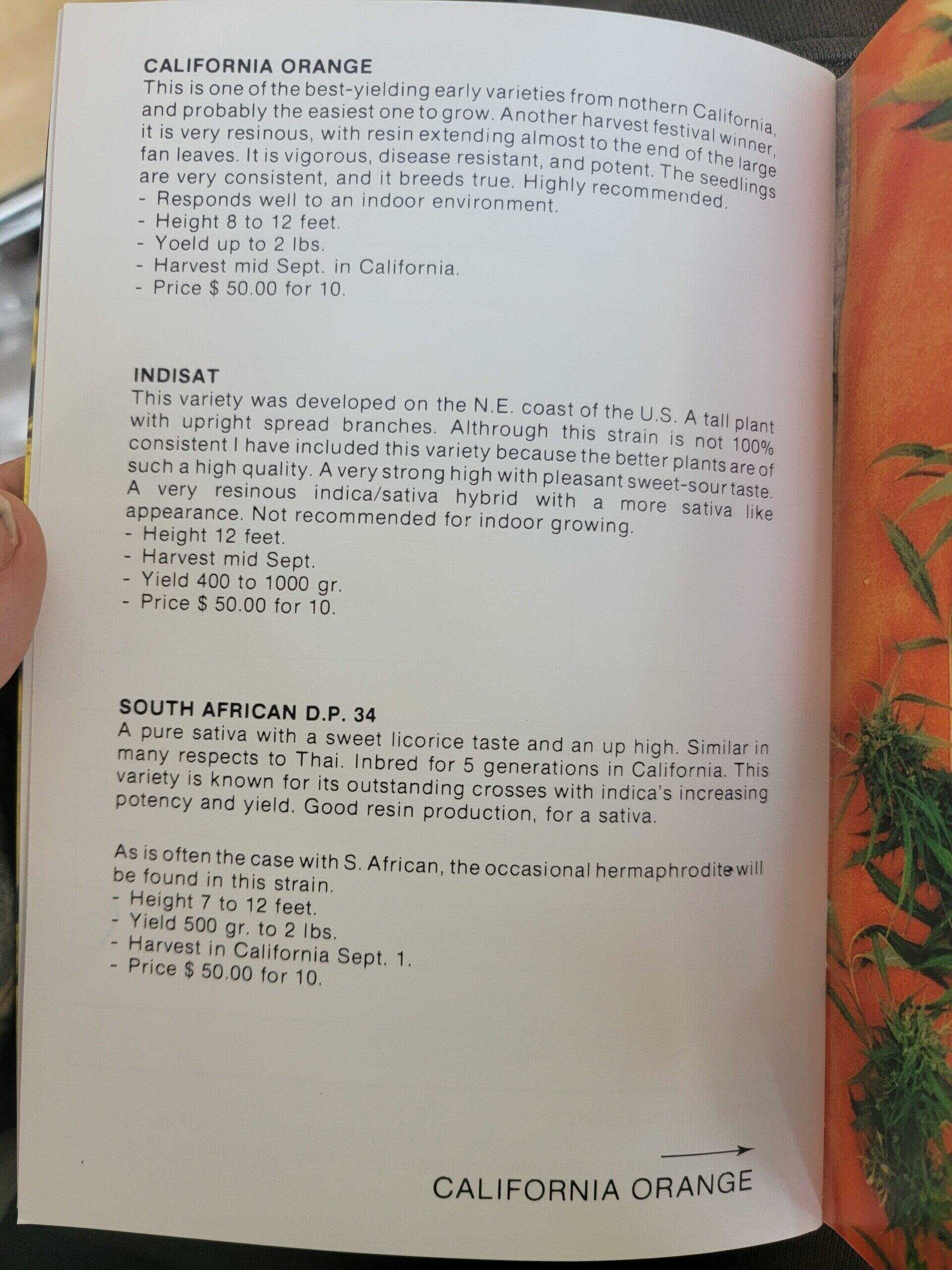
With the first money he earns, Nevil buys a grand 19th-century estate in the Dutch countryside. There he begins breeding and growing cannabis on a large scale, indoors and in greenhouses. The following five years of the second half of the 1980s can be considered the peak years of Nevil’s breeding legacy. Gradually, he succeeds in obtaining significant varieties from around the world, and under his hands cultivars are created that become the foundation of the modern cannabis scene. Nevil obtained and preserved for future generations Northern Lights, Early Pearl, G13, California Orange, Big Bud from the United States, as well as many landrace varieties from around the world.
After a few years, High Times editors notice Nevil’s success and publish an interview with him in 1987, in which they rename him the king of cannabis. Nevil becomes a celebrity overnight and, unfortunately, also comes to the attention of the American anti-drugs police DEA. Under the code name Green Merchant, it gathers evidence, and in July 1990 Nevil is arrested while visiting relatives in Australia.
You may be interested in: The most famous varieties of Dutch coffeeshops
In the end, he spends about 11 months in custody and, after being released on bail, flees from Australia back to the Netherlands, which decides not to extradite him. Nevertheless, in 1991 Nevil is forced by circumstances to sell his collection and company to the Dronkers brothers, who transform The Seed Bank of Holland into Sensi Seeds. In the following years Nevil works for Sensi Seeds as chief breeder, but in 1995 he decides to leave the company and with it a large part of his plants. The last strain Nevil bred for Sensi Seeds is Jack Herer.
After leaving Sensi Seeds, Nevil Schoenmakers continues to devote himself to breeding and, together with Arjan Roskam, stands at the birth of the seed bank Green House Seed. Another of his collaborators in later years is the Australian breeder Scott Blakey, alias Shantibaba, with whom he created a number of excellent varieties. Nevil Schoenmakers died on 30 March 2019 at the age of 62.
Nevil Schoenmakers – famous varieties
 Northern Lights – “Aurora Borealis” was one of the basic building blocks of most of Nevil’s successful breeding projects. This super-potent indica originating from the north-western coast of the United States, bred by Vietnam War veterans, could add strength to everything it was crossed with. The autoflowering version Northern Lights Auto from Green House Seed is everything you could wish for from an auto. It is a resilient variety that you can harvest just 10 weeks from germination.
Early Skunk (Skunk # 1 x Early Pearl) – A mention of this variety can already be found in the 1987 catalogue of The Seed Bank of Holland, where Nevil describes it as a high-yielding plant suitable for outdoor growing. For lovers of cannabis history, it is great news that Sensi Seeds still offers Early Pearl in its catalogue today, so you can try it too.
Super Silver Haze (Skunk # 1 x Northern Lights x Haze) – Haze was, and still is, considered something exceptional by many cannabis smokers. The problem is that most pure Haze varieties flower for more than 12 weeks, sometimes much longer. That is why Nevil tried to cross long-flowering Haze with dominant indicas, which shorten the flowering time, and with Skunk, which gives the variety compactness. The result is Super Silver Haze, a variety Nevil bred with Shantibaba for Green House Seed.
Big Bud – Big Bud was among the sought-after commercial varieties in 1980s America, thanks to its huge yields. Nevil obtained his clone from the original source, and seeds of its crosses quickly became hot property. Their scarcity and price increase are mentioned directly in the 1987 catalogue of The Seed Bank of Holland. Big Bud can give varieties high yields and a robust structure, which is clearly seen in Super Bud (Big Bud x Skunk #1) from Green House Seed.
For more information about cannabis varieties and the history of this plant, and much more, visit the HiSeeds blog.