
More than one grower boasts that their crop outshines all the others. But what does genuine cannabis quality actually consist of? Cannabinoid content, appearance and terpene profile are certainly important, but they will by no means tell you everything. The essentials lie in the details. Anyone who wants to learn how to assess cannabis quality like a professional must learn to look at it differently from an ordinary consumer.
A sommelier can help you choose a quality wine. They must not only know its origin and suitable pairings, but also be able to immediately detect any hidden defect in the selected wine. Cannabis is much the same. A true expert does not look only at its origin, aroma or potency, but assesses a whole range of details in every sample. These reveal any shortcomings in the cultivation, processing or storage of the sample.
What not to overlook when assessing cannabis
Poor flower structure: The overall appearance and structure of the buds reveal a great deal, especially whether the flowers come from a healthy plant. If the plant was cultivated correctly and had sufficient nutrients and light, the flowers should be well developed, dense and free from obvious defects. Buds from plants cultivated incorrectly or in unsuitable conditions tend to be loose, faded and not very dense.
Immature cannabis: Cannabis harvested prematurely may smell pleasant and have resin on it, but it will not contain nearly as many cannabinoids and terpenes as cannabis harvested at peak maturity. The best way to identify immature cannabis is to take a close look at the heads of the trichomes, the small glands on the surface of the flowers. They are easiest to see under a magnifying glass with at least 30× magnification or with a camera macro lens. On immature flowers, most of the trichome heads will be transparent, whereas mature ones are milky and cloudy. Overripe trichomes are amber in colour.
You may also be interested in: When to harvest cannabis? How to recognise mature flowers
Bananas: Cannabis tends towards hermaphroditism, so small male flowers may sometimes appear on female flowers during flowering. They are shaped like small bananas and release a small amount of male pollen when they open, which can lead to the formation of seeds. Seeded buds not only taste significantly worse, but also contain fewer cannabinoids and terpenes. Therefore, if you notice male flowers on a sample being assessed, pay close attention and inspect the inside of the buds carefully to see whether you can find any seeds.
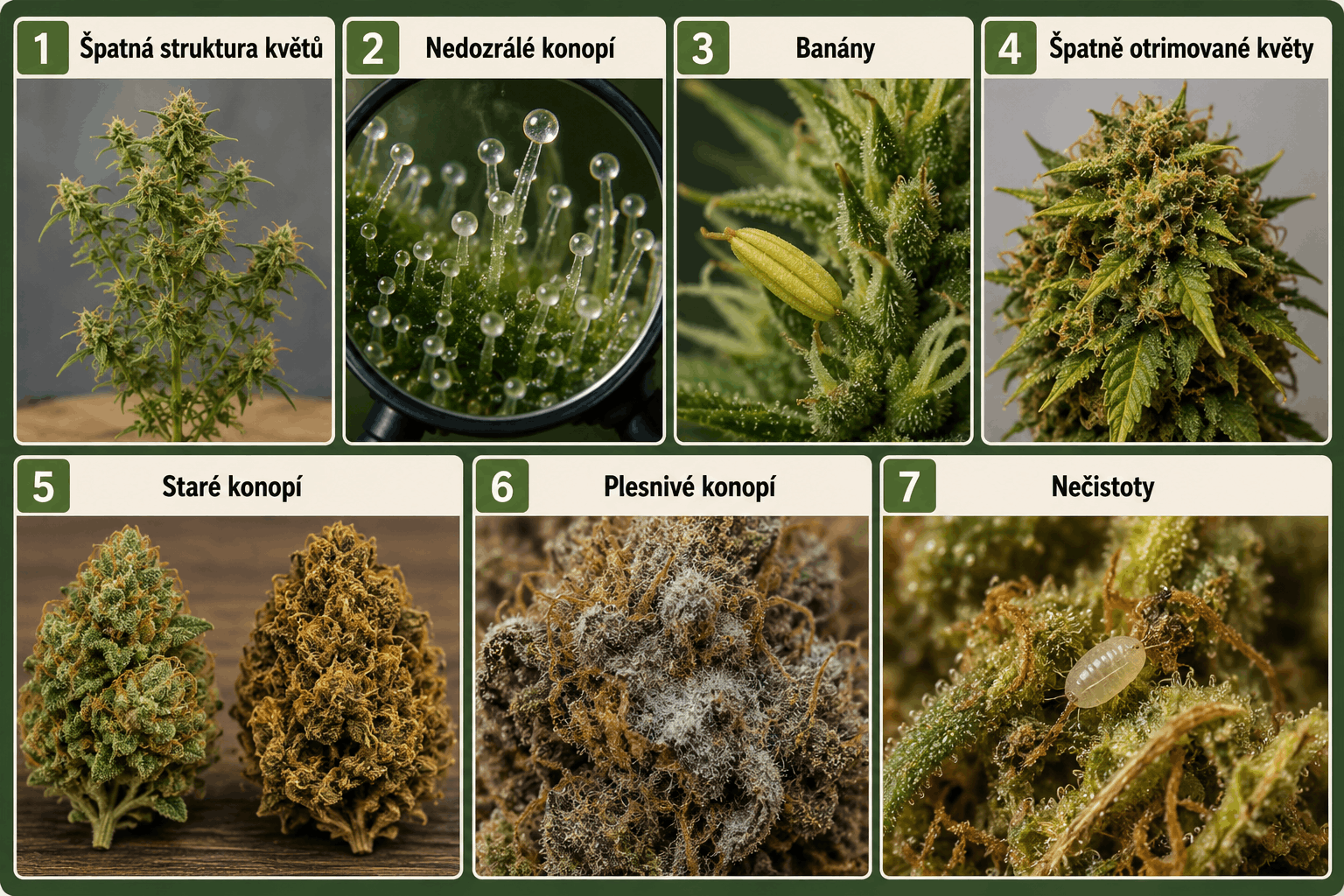
Poorly trimmed flowers: You can recognise genuinely high-quality cannabis by its immaculate trimming, among other things. Although it may seem that cleaning the flowers is merely a cosmetic matter, the opposite is true. Even the smallest leaf on a bud will give cannabis an unpleasantly bitter aftertaste when smoked.
Old cannabis: Even when buds are stored in darkness and cool conditions, they do not last forever. Most strains taste and smell best for several months to half a year after harvesting and drying. Cannabis that is more than a year old has probably lost some of its terpenes, and some of the THC in it will have degraded into CBN. Cannabis stored for a long time can be recognised by its golden-brown colour and slightly sour, stale aroma. Fresh cannabis, by contrast, has a pronounced terpene profile and a healthy green colour.
You may also be interested in: How to dry and store cannabis correctly so that it lasts a long time
Mouldy cannabis: Any trace of mould should be a warning sign. Rotting flowers affected by grey mould (botrytis) tend to have an unusually dark colour and a foul smell. If you have any suspicions, break open the bud and look inside. If you find grey or reddish traces around the stems, it is probably rot. Powdery mildew, which looks like white dust, mainly affects leaves. It is therefore rarely found on dried flowers. If you find white traces of mould on the flowers, this indicates that the infection was genuinely severe. Remember that smoking or consuming mouldy cannabis exposes you to a serious health risk.
Insects or other contaminants: Some types of insects live or lay eggs in flowers, and it goes without saying that a dead beetle will not particularly improve the cannabis experience. Dust can also have a very significant effect on cannabis quality. This is primarily a problem with plants grown outdoors in a persistently dusty environment. Flowers full of dust often burn poorly, taste worse and are more difficult to use for making clean extracts. Many experts say that the cleanliness of cannabis is best recognised by the colour of the ash after ignition. If the ash is light in colour and does not feel gritty when rubbed between the fingers, the cannabis is clean. Dark, rough ash, on the other hand, is a sign of contaminants.
No one becomes a cannabis connoisseur overnight. Gaining the necessary experience often requires tasting thousands of samples, which can take many years. And that is not all. A true connoisseur should also be well acquainted with the history of cannabis and the latest scientific findings about this wonderful plant. If you would like to learn more, follow us on the HiSeeds blog, where we regularly bring you information from the world of cannabis.