
Few people today doubt the medicinal power of cannabis. In shops, you can buy cannabis ointment for sore joints, CBD oil for a good night’s sleep, and those who wish can ask a doctor for prescription cannabis. But is cannabis really as medicinal as many people believe? The truth is that many myths and half-truths circulate in public discourse, and at HiSeeds we have decided to set the record straight. So what does current science say about the medicinal power of cannabis?
 Before we look in detail at the evidence for the medicinal properties of cannabis, let us first explain what lies behind the effects of this herb on the human body. The main active compounds in cannabis are cannabinoids, terpenophenolic compounds, of which more than one hundred have been identified in this plant. The effects of two cannabinoids are best described – tetrahydrocannabinol (THC) and cannabidiol (CBD) – which occur in cannabis in the greatest amounts. The effects of other so-called minor cannabinoids, such as CBG, CBC, CBDC and others, have been studied less, but according to studies many of them could potentially have medicinal effects.
Cannabinoids act on the CB1 and CB2 cannabinoid receptors in the human endocannabinoid system (ECS), a regulatory system that maintains homeostasis (balance) in our body across a range of processes such as pain, inflammation, mood, appetite, stress response, memory and learning, and immunity. The discovery of the ECS at the beginning of the 1990s was led by R. Mechoulam and his experiments with THC and his effort to uncover how this substance affects the brain. To the researchers’ surprise, they found that our body produces its own endocannabinoids, the first of which they named anandamide.
However, cannabinoids are far from the only substances in cannabis that could have medicinal potential. The most studied are terpenes (e.g. myrcene, caryophyllene), aromatic compounds, some of which have anti-inflammatory, analgesic and neuroprotective effects. Then there are flavonoids and other phenolic compounds, especially cannaflavins A, C, stilbenoids (canniprene), lignanamides (cannabisin A, F) and other polyphenols with significant antioxidant, anti-inflammatory, antiproliferative and potentially neuroprotective effects. Cannabis also contains alkaloids, sterols and triterpenoids, which contribute to the plant’s antioxidant, anti-inflammatory and other bioactive effects. Studies often emphasise that the combination of cannabinoids with terpenes and phenolic compounds may increase efficacy while also altering the profile of effects compared with isolated cannabinoids within the so-called entourage effect.
You may be interested in: What do the aromas of cannabis strains reveal to us?
What cannabis treats
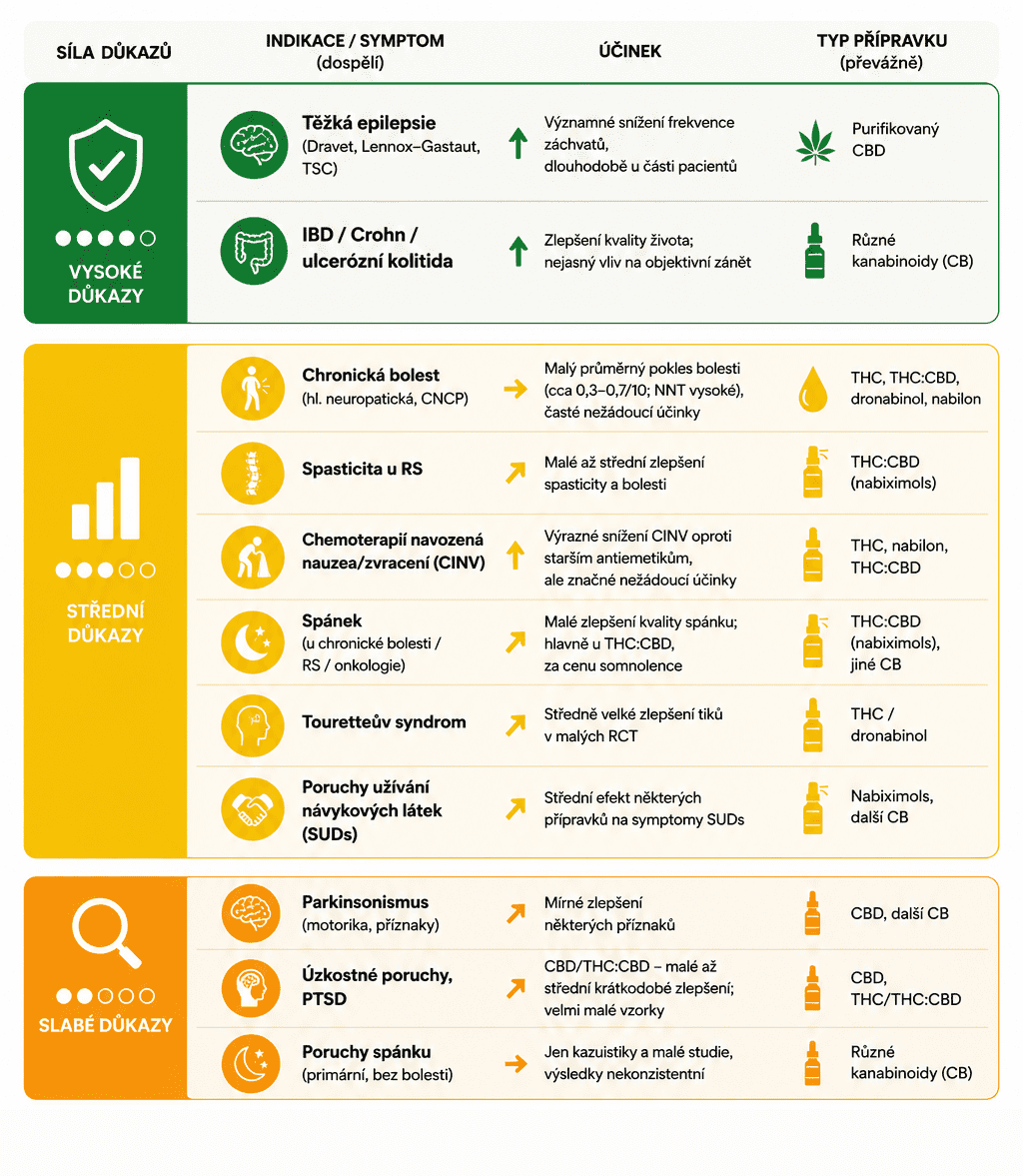 The strongest evidence for the medicinal potential of cannabis is in the case of chronic pain, nausea during chemotherapy, the treatment of spasticity and some severe forms of childhood epilepsy. It has repeatedly been shown that cannabis medicines containing THC or a combination of THC and CBD reduce pain, especially in diabetic neuropathy, cancer, rheumatoid arthritis and inflammation. As an adjunct medicine, cannabis is used in the treatment of cancer, not only to relieve pain, but also to suppress the nausea that accompanies chemotherapy. Cannabis can also relieve muscle tension and spasms in some patients with spasticity. Last but not least, preparations with CBD have proved to be extremely effective in the treatment of people affected by Dravet syndrome and Lennox–Gastaut syndrome.
Research into cannabis as a medicine for chronic inflammation, anxiety, PTSD, migraines, sleep disorders, Tourette syndrome and Parkinson’s disease also appears promising. Patients with Crohn’s disease or ulcerative colitis often report relief from symptoms in studies (abdominal pain, diarrhoea, loss of appetite, stress) and a better quality of life, however cannabis use usually has no effect on improving endoscopic findings. Some studies also suggest that CBD, or a combination of THC and CBD, may have a calming effect on some people and help with sleep quality. CBD has been shown to improve some symptoms of Parkinson’s disease. There is some evidence for the effectiveness of THC in Tourette syndrome.
The effect of cannabis on cancer and neurodegenerative diseases or depression is inconclusive or, for now, insufficiently supported. In the case of depressive disorders, there is still not enough clinical evidence for the effectiveness of cannabinoids, and there are also concerns about worsening symptoms or dependence. Contrary to common anecdotal claims, the ASCO guideline does not recommend using cannabinoids as anticancer treatment, although they may help suppress pain and nausea.
The medicinal potential of cannabis is undoubtedly one of the most interesting topics in modern medicine. However, we must remember that although many effects of cannabis are confirmed by high-quality clinical studies, research in a number of other areas is still ongoing or does not yet offer clear answers. If you are interested in more news from the world of cannabis or are looking for information on the best strains, visit our HiSeed blog.
Sources:
Bilbao, A., & Spanagel, R. (2022). Medical cannabinoids: a pharmacology-based systematic review and meta-analysis for all relevant medical indications. BMC Medicine, 20. https://doi.org/10.1186/s12916-022-02459-1.