
Have you bought from HiSeeds and do not want to make any mistakes during germination? Simply follow a few basic rules and avoid the most common errors. We have prepared answers to the ten most frequently asked questions about cannabis germination for you.
In the following lines, we answer the most common questions about germination in detail. If you are looking for a complete guide to cannabis germination, you will find it on our blog here.
1. Which germination method is best: paper towel, water, or straight into the substrate?
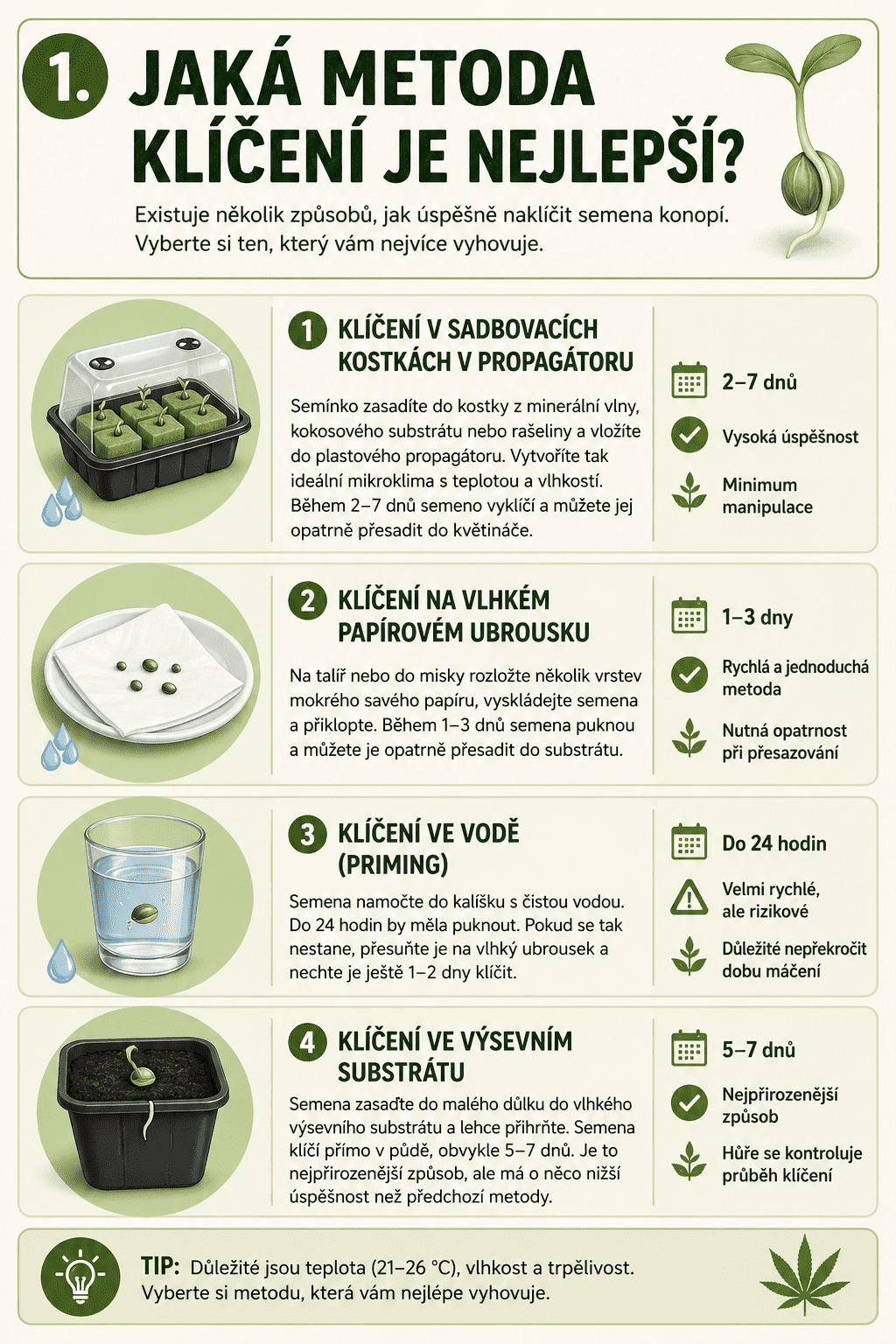
There are several methods for germinating cannabis seeds. Germination in water or on a paper towel has the advantage that you can quickly see whether the seeds are viable. Germination in a seed-starting substrate takes a little longer and you cannot see the seeds, but you do not need to handle them and there is no risk of damaging the sprout. Our preferred method is germination in propagation cubes in a plastic propagator, in which the seeds germinate quickly and you do not need to touch them when transplanting.
- Germination in propagation cubes in a propagator is an excellent method that even a beginner can manage. You place the seed into a small cylinder or cube made of mineral wool, coconut substrate or peat, which you put into a plastic propagator. This creates the perfect microclimate with ideal temperature and humidity. Within 2 to 7 days, the seed should germinate and produce the first two cotyledons, after which you can carefully transplant it into a pot.
- Germination on a damp paper towel is quick and simple. Just lay several layers of wet absorbent paper on a plate or in a plastic bowl, place the seeds on it and cover them. Within 1 to 3 days, the seeds will split and you can carefully transplant them into the substrate.
- Germination in water (priming) is very fast, but also risky. Soak the seeds in a small cup of clean water, where they should split within 24 hours. If they do not, move them onto a damp paper towel and let them germinate for another 1 to 2 days.
- Germination in a seed-starting substrate is the most natural method, in which you do not handle the seeds at all after planting. The disadvantage is that germination in soil has a slightly lower success rate than the previous methods. Use only seed-starting substrates for germinating cannabis seeds. Carry out germination in small pots for raising seedlings filled with moist substrate. Plant the seeds into a small hole at roughly twice their length and cover them with a small amount of soil. Germination directly in a soil substrate takes the longest, usually 5 to 7 days.
2. How long does cannabis seed germination take?
 The speed of germination depends on several factors, especially the germination method, the age of the seed stock and environmental conditions. Fresh, high-quality seeds will split and send out the first root within 24 to 72 hours. Older or less vigorous seeds may take 5 to 7 days or longer to germinate. If the seeds do not germinate within two weeks, they have probably already lost viability and there is no point waiting any longer.
Germination takes place in two phases. During the first phase, the seed first absorbs water, enzymes begin to break down nutrients in the endosperm and the embryo is activated. This process takes hours. In the second phase, the seed splits and the root begins to grow. Once the root is 1 to 2 centimetres long, the seedling is ready to be transplanted into the substrate.
3. What temperature is ideal for cannabis germination?
Cannabis seeds germinate best at temperatures between 21 and 26 °C. At temperatures below 18 °C, metabolic processes slow down and the germination time is extended, while the risk of mould attacking the seed increases. At temperatures below 15 °C, most cannabis seeds will not germinate. Temperatures that are too high, exceeding 28 °C, also significantly reduce the chance of germination.
During germination, it is important that the temperature does not fluctuate. The easiest way to achieve this is by germinating in a plastic propagator placed in a warm spot away from direct sunlight. If you have trouble keeping the seeds warm, look for heating mats for germination, which you can get in any grow shop. It is definitely not a good idea to germinate in direct sunlight (for example on a windowsill) or on a hot radiator.
4. What water should be used for germination?
You can use ordinary tap water for cannabis germination, but it is better to let it stand overnight or boil it to remove excess chlorine. This is especially important if you want to treat the seeds with microbial products. If your tap water is hard with an EC above 0.6 mS/cm, it is better to use distilled or demineralised water for germination. The water temperature for germination should be 20 to 24 °C.
5. Why do cannabis seeds not germinate?
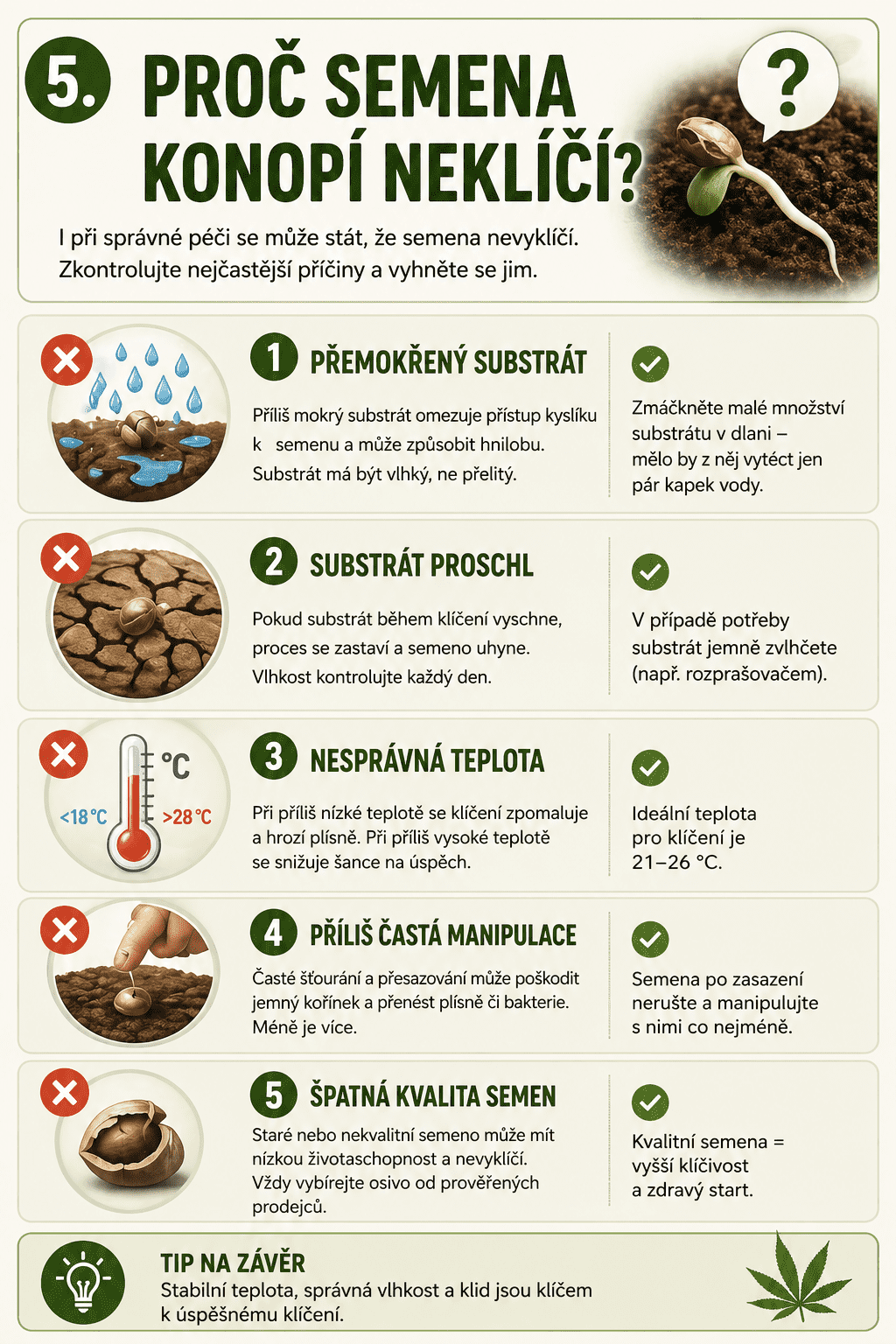
Nature is not 100%, so it may happen that some of your seeds do not germinate. If you buy quality seed stock from a reliable supplier and follow the correct procedure, at least 8 out of 10 seeds should germinate. If that is not the case, check once again whether you are observing the following:
- Overwatered substrate – If you are germinating in a seed-starting substrate, make sure it is moist but not waterlogged. You can tell that the germination substrate is properly moistened when, if you squeeze a small amount in your palm, only a few drops of water should come out between your fingers.
- The substrate has dried out – If the substrate dries out too much at any point during germination, the process stops and the seed dies. Therefore, check the moisture of the substrate every day and, if necessary, moisten it with a spray bottle.
- Incorrect temperature – The optimal temperature for germination is 21 to 26 °C. At temperatures below 18 °C, germination slows down and the risk of the embryo developing mould increases. Temperatures above 28 °C also noticeably reduce germination success.
- Too much handling – Some growers cannot resist poking around the seeds and handling them in various ways during germination. The more you touch a germinating seed, the more likely you are to damage the fragile root or transfer mould or bacteria to it.
6. Do cannabis seeds need light during germination?
 No, cannabis seeds can germinate in darkness or shade. They begin to need light from the moment the first two round cotyledons appear above the substrate. From this point on, the plant is capable of photosynthesis and will need adequately intense light.
If you are growing indoors, place the seedlings under weak light with a vegetative spectrum at a photoperiod of 18 hours of light and 6 hours of darkness. When raising cannabis seedlings for outdoor growing, it is also better to give the plants light for the first week or two, but they will also grow on a windowsill where they receive light for at least 14 hours a day.
7. When should you start germinating seeds for outdoor growing?
The outdoor cannabis growing season in our latitudes lasts approximately from May to October. Most growers germinate seeds at home, where they raise seedlings that are planted outside as soon as the weather is suitable. This is usually in the second half of May or when night temperatures do not fall below 10 °C.
How far in advance you should germinate depends on whether you are growing “classic” photoperiod or autoflowering strains. You can start photoperiod seeds germinating as early as mid-April or even earlier if you have a fully equipped grow box at home and want to raise large, healthy seedlings. However, if you plan to keep the seedlings on a windowsill, it is better to wait until about three weeks before the planned planting date before germinating.
Autoflower cannabis strains are characterised by flowering independently of the length of day and night, usually about three to five weeks after the seeds germinate. Another specific feature of autoflowers is that they do not like repeated transplanting or pruning. For the